
Six two-seat airplanes, several different priorities. Here’s how to find the RV that fits the flying you want to do.
A faster airplane can make a weekend trip practical. A comfortable passenger can make you want to take that trip again. And an airplane that’s enjoyable to fly can give you a reason to go somewhere even when you don’t need to.
That combination explains much of the appeal of a Van’s RV. You can shop for useful traveling performance without giving up the kind of hands-on flying that brought you to taildraggers in the first place.
The harder part is choosing one.
An RV-4 and an RV-14 both carry two people, but they answer different questions about space, equipment, and the ownership experience. An RV-7 and an RV-9 look similar enough to confuse a buyer who hasn’t studied them. Their wings and intended uses are different. A well-built RV-6 deserves more consideration than simply being passed over for a later model.
There’s another factor that matters throughout this discussion: these are kit designs. A completed airplane reflects the builder’s work, equipment decisions, modifications, maintenance, and flight history. The model tells you where to start. The individual aircraft determines what you’re buying.
This guide focuses on six Van’s tailwheel models listed on Taildraggers.com: the RV-4, RV-6, RV-7, RV-8, RV-9, and RV-14. It compares their design features and offers buying judgments based on those differences. It is not a flight test of six individual airplanes or a claim that one is best for everyone.
First, get the model names straight
In the RV-6, RV-7, RV-8, RV-9, and RV-14 families, the A suffix identifies the nosewheel version. An RV-7 is the taildragger; an RV-7A has tricycle gear. The RV-4 in this guide is a tailwheel design. [1–6]
That’s worth checking when you search. Ads and casual conversation sometimes shorten the model name. If you want the tailwheel version, confirm the aircraft’s actual designation, configuration, and documents.
All six aircraft discussed here have two seats. The first useful decision is where you want the second person to sit.
| Model | Seating | Why put it on your shortlist? | The buying question |
| RV-4 | Tandem | Compact sport airplane with traveling ability | Will you and your passenger fit comfortably with the load you need? |
| RV-6 | Side by side | Established design worth comparing with newer aircraft | Does this example’s condition and equipment make it the better purchase? |
| RV-7 | Side by side | A balance of travel and aerobatic design capability | Do you want both missions, and is this aircraft equipped appropriately? |
| RV-8 | Tandem | Centerline seating with more room than the compact RV-4 concept | Does the rear seat work for the person coming along? |
| RV-9 | Side by side | Travel-focused design with a different wing and lower-power emphasis | Is ordinary cross-country flying your main goal? |
| RV-14 | Side by side | A larger cabin and more integrated kit design | Is the extra space worth the ownership cost for you? |
The mission descriptions are editorial guidance, not performance guarantees. Manufacturer design references appear below; actual aircraft may differ.
Van’s RV-4 for sale: a compact airplane with a clear purpose
The RV-4 puts the pilot in front and the passenger behind. Its narrow fuselage keeps the pilot on the centerline and gives the airplane a compact feel. Van’s designed it around modest four-cylinder power rather than the assumption that every buyer needed the largest possible engine. Familiar installations include 150/160-horsepower O-320s and 180-horsepower O-360s.
The attraction is easy to understand if much of your flying is solo. You sit in the middle, look over a relatively narrow nose, and have an airplane intended for both sport flying and travel. There is a second seat when someone wants to come along.
That second seat deserves an honest look before you buy. Try both positions in the actual airplane, with the cushions and controls that are installed. Check headroom, legroom, restraint fit, entry and exit, and whether the passenger can get comfortable without affecting your controls. A ten-minute demonstration doesn’t tell you everything about a three-hour trip.
The RV-4 is operated from the front seat. A rear stick does not by itself establish a complete rear-seat control installation or make the airplane suitable for the instruction you have in mind. Ask what is fitted and how you’ll arrange your transition.
Traveling also requires some discipline about what comes along. Van’s lists a reference fuel capacity of 32 gallons and baggage allowance of 50 pounds. Those are useful design comparisons with the larger models, not permission to load any RV-4 that way. The aircraft’s weight and balance and compartment limits still decide the load.
The RV-4 makes sense for a buyer who wants tandem seating, enjoys keeping an airplane relatively simple, and doesn’t need a large cabin to enjoy a trip. There’s little value in buying one because it looks right if your usual passenger finds it uncomfortable.
It also deserves to be judged as an RV-4. A later model may offer more room or fuel, but those additions are worthwhile only if they improve the flying you’ll actually do.
Browse Van’s RV-4 for sale listings.
Van’s RV-6 for sale: don’t dismiss the earlier airplane
The RV-6 brought side-by-side seating to the two-seat RV line. Van’s replaced the RV-6/6A kit design with the RV-7/7A in 2001. That history helps explain the model relationship, but it doesn’t establish which completed airplane you should buy. An RV’s completion date also need not match the era in which its kit was introduced.
For a pilot who usually takes someone along, side-by-side seating is a practical feature. You can share navigation, look at the same panel, and talk without one person sitting behind the other. Whether that works comfortably depends on both occupants and the particular interior. Try the cabin together.
The RV-6 offers the sport-and-travel combination that draws many buyers to the family. Van’s lists 150–180 horsepower, 38 gallons of fuel capacity, and a 100-pound baggage allowance as design references. Its aerobatic design capability must be considered separately from its everyday loading.
An older airplane can bring an opportunity to buy the equipment you need without paying for a later design. It can also bring aging hoses, wiring changes, repairs, or a panel that would cost more to replace than you expect. Neither outcome follows automatically from the model name.
Compare finished airplanes rather than an RV-6 brochure against an RV-7 brochure. Put the build records, recent use, installed engine, propeller, empty weight, and maintenance side by side. Then price the work each aircraft needs to become the airplane you want.
A smaller or older panel isn’t necessarily a defect. If your flying is fair-weather travel and local recreation, a straightforward, serviceable installation may suit you. If you need substantial upgrades, get a realistic estimate before treating them as an easy project after the sale.
The RV-6 belongs on the shortlist when condition and value matter more to you than having a later model number. A good example should have to earn the purchase through inspection. It shouldn’t have to apologize for being a Six.
Compare Van’s RV-6 for sale listings.
Van’s RV-7 for sale: travel and sport flying in the same plan
The RV-7 followed the RV-6 with a revised design and a more developed kit. It keeps side-by-side seating and the combination of cross-country use and aerobatic design capability. Reference fuel capacity increases to 42 gallons, with a listed 100-pound baggage allowance. Sliding and tip-up canopy arrangements appear in the family.
That makes it a useful starting point for a buyer who wants to travel with one person and still has an interest in sport flying. You don’t have to plan aerobatics on every outing to value that option. You do need a realistic idea of whether you’ll pursue the instruction and stay proficient enough to use it.
The engine and propeller deserve their own comparison. An RV-7 with a fixed-pitch propeller and a relatively simple panel can be a different ownership decision from one with a constant-speed propeller, extensive avionics, and more power. Van’s provides for several engine installations; the specific installation and its limits need to be identified.
More equipment can improve a trip. It also adds weight, expense, and systems that need to work together. The useful question is whether the installed combination gives you what you need after accounting for two occupants, fuel, and bags.
The canopy is another feature to examine in person. Test access, latching, visibility, and the condition of the installation. The fact that a canopy style is popular doesn’t tell you whether this particular example fits or seals properly.
For many buyers, the RV-7 will be the aircraft against which the others are compared. That is a shopping judgment, not a claim that it wins every comparison. The RV-9 may fit a travel-only mission better. The RV-8 may suit a pilot who strongly prefers tandem seating. The RV-14 may settle a cabin-fit problem the RV-7 doesn’t.
Start with the Seven if you want side-by-side seating and a broad range of flying. Then give the actual aircraft, and the alternatives, a fair inspection.
Explore Van’s RV-7 for sale listings.
Van’s RV-8 for sale: tandem seating with room to go somewhere

The RV-8 revisits the tandem layout with a roomier cockpit than the compact RV-4 concept. It is operated from the front seat and uses a sliding canopy. Its two baggage compartments—one forward and one aft—give the owner more loading options than a single compartment, subject to the individual limits and balance calculation.
That arrangement matters because tandem seating changes more than the view from the pilot’s seat. It changes where the passenger sits, how you communicate, how you share tasks, and where equipment can be placed. If you want the pilot on the centerline, the RV-8 deserves close attention. If you want someone beside you helping with a chart, it may not.
Van’s lists 42 gallons of reference fuel capacity and a combined baggage allowance of 125 pounds. The standard kit includes a rear stick; rear throttle and rudder controls are configuration questions rather than assumptions. Ask exactly what the rear occupant can operate in the airplane for sale.
The RV-8 accepts a range of engines. A common 180-horsepower installation and a larger-engine example should be compared on more than climb claims. Weight, propeller, balance, fuel requirements, and maintenance all affect the result. A lower-powered, lighter airplane may fit your flying perfectly well.
The passenger test should be part of the buying process. Can your usual companion see comfortably, reach what they need, and tolerate the seating position for the length of trip you expect? A pilot’s enthusiasm for the front seat doesn’t answer those questions.
For aerobatic plans, check the particular wing and applicable loading limits. Van’s guidance distinguishes earlier RV-8 wings from the later “Dash One” wing. This is an example of why a familiar model name cannot replace reviewing the aircraft’s construction and records.
The RV-8 suits a buyer who specifically wants tandem seating and intends to use the airplane for more than occasional short rides. Choose it because that arrangement works for your flying, with your passenger included in the decision.
Browse Van’s RV-8 for sale listings.
Van’s RV-9 for sale: give the traveling mission its due
The RV-9’s most important difference is its wing. It has a longer, narrower wing using a Roncz airfoil and long-span slotted flaps. Van’s designed it around efficient everyday flying, useful low-speed behavior, and smaller engines. The published engine range is 118–160 horsepower.
The RV-9 is not designed or intended for aerobatics. That should settle the comparison early if loops and rolls are a serious part of your plan. It should also stop a buyer from treating a modified engine or someone else’s operating habits as permission to change the mission.
For the buyer whose flying consists of local trips and cross-countries with one passenger, that focus can be a good thing. You don’t need to pay for a capability merely because another model offers it. You need an airplane that does the ordinary trip well.
The RV-9 shares its basic side-by-side fuselage and cabin with the RV-7 family, but the different wing produces a different flying emphasis. Van’s describes firmer control forces and less rapid response than its sportier models. The reference fuel capacity is 36 gallons, with up to 100 pounds of baggage when weight and balance permit.
Those distinctions make an RV-7 versus RV-9 comparison more useful than arguing which is the better airplane. Start with your expected use. If you want aerobatics, the Nine isn’t the answer. If you want travel with no intention of aerobatics, give its wing, engine requirements, and handling priorities proper consideration.
The larger wing also deserves careful transition work. Learn the aircraft’s energy management and landing behavior rather than assuming experience in another RV makes the differences irrelevant. A design intended to be approachable still needs to be flown accurately.
An RV-9 is worth seeking out if you want a two-seat taildragger for going places and enjoy the idea of an airplane designed around that work. It doesn’t need to be described as a lesser RV to explain why someone would choose it.
Compare Van’s RV-9 for sale listings.
Van’s RV-14 for sale: more room can change how often you travel
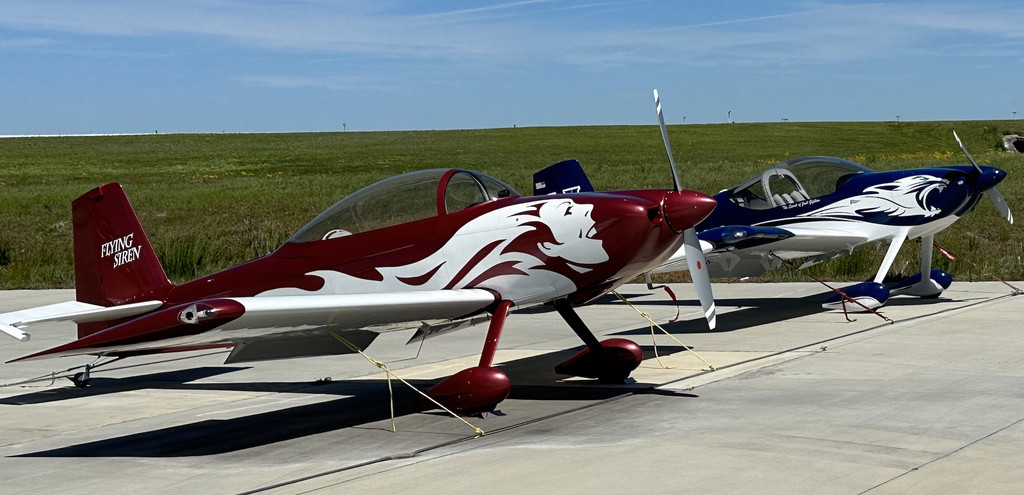
The RV-14 addresses a problem that specifications don’t always capture: an airplane can have the performance you want and still be too uncomfortable to enjoy for long.
The larger side-by-side cabin, more upright seating, and tip-forward canopy make cabin space and access important reasons to consider this model. Van’s brochure lists a 46-inch cabin width and 50 gallons of fuel capacity. The design retains aerobatic capability while giving two occupants more room.
The canopy is more than an appearance choice. Its opening arrangement provides access for boarding, baggage, and work behind the panel. Large slotted flaps are another identified design feature. Familiar powerplants include the 210-horsepower IO-390A and 215-horsepower IO-390-EXP119.
The RV-14 kit also reflects further development in pre-punched construction and available systems packages. That can help explain differences in build process and installation consistency. It does not establish that every completed Fourteen is well built, or that an earlier RV cannot be excellent. The builder’s decisions and work still need to be inspected.
For buyers who regularly travel with a passenger, the added space may be worth more than a small performance difference. Test the seating with the person who will use it. Reach the controls. Check how you enter and leave. Imagine the cabin after several hours, not just while standing beside it at a fly-in.
Then work through the costs. Compare purchase price, engine and propeller reserves, insurance, and the equipment you actually need. More room can be worth paying for. Buying it just because it is the later design is a weaker reason.
The RV-14 belongs high on the list when a smaller cockpit is the reason you would otherwise avoid a two-seat RV. If an RV-7 already fits both occupants and the mission comfortably, inspect the two individual aircraft before deciding what the extra room is worth.
Explore Van’s RV-14 for sale listings.
A few numbers worth comparing—and the ones worth questioning
Fuel capacity and baggage limits help describe the design differences. They do not establish payload, endurance, usable fuel, or the loading of a particular aircraft.
| Model | Manufacturer reference fuel capacity | Manufacturer reference baggage allowance | Practical implication |
| RV-4 | 32 US gallons | 50 lb | Pack deliberately for two-person trips |
| RV-6 | 38 US gallons | 100 lb | Check cabin comfort and loaded weight together |
| RV-7 | 42 US gallons | 100 lb | Compare fuel needs with the installed equipment’s weight |
| RV-8 | 42 US gallons | 125 lb combined | Respect the separate compartment limits and balance |
| RV-9 | 36 US gallons | 100 lb, weight and balance permitting | Plan the travel mission around actual fuel and load |
| RV-14 | 50 US gallons | 100 lb | More fuel capacity still requires a loading decision |
References: Van’s model pages and RV-14 brochure. These are design reference figures, not independently measured values for the aircraft in any listing. Verify the aircraft’s documents, tank configuration, compartment restrictions, current empty weight, and operating limitations.
Cruise figures need more context than a single comparison table usually gives them. Engine power, propeller, altitude, power setting, mixture, configuration, and weight all affect the result. Top speed is not normal cruise speed. Miles per hour and knots are not interchangeable.
If a seller quotes a speed, ask how it was established. If fuel burn is part of the claim, ask whether it was measured at the same setting. A good comparison uses the conditions you expect to fly, with adequate reserves, rather than combining each airplane’s most attractive number.
Buying a flying RV: the work behind the panel matters
The model comparison gets you to a shortlist. The next job is understanding the particular airplane. Van’s own used-aircraft guidance emphasizes RV-experienced inspection, attention to the engine installation, aircraft paperwork, and transition training.
Start with the structure and build history
Have an independent mechanic with relevant RV experience inspect the aircraft. A builder who knows the design can be a useful additional resource, but enthusiasm for RVs is not enough on its own.
Ask the inspector to explain what they found, what needs attention, and what remains uncertain. Construction photographs and build records can help establish how the airplane came together. Repairs, changes of owner, and years of maintenance are part of the same story.
A later model number doesn’t settle this. Neither does a low total time. A lightly used airplane can still have problems, and a regularly flown one can be carefully maintained.
Inspect the installation as a complete system
Identify the actual engine and propeller, then examine how fuel, ignition, cooling, controls, exhaust, and electrical power have been installed. With a kit-built aircraft, the engine name alone doesn’t establish a standard installation.
For a buyer, useful questions include whether the systems are documented, whether another mechanic can follow the wiring and plumbing, and whether the equipment behaves as described. An expensive display can be well installed or poorly installed. Its purchase price does not tell you which.
Work through the records and current service information
Review the airworthiness certificate, registration, current weight and balance, aircraft-specific operating limitations, and maintenance records with qualified help. Check the flight-test history and subsequent changes, particularly if the installed aircraft differs significantly from its earlier configuration. [10]
Have the inspector identify applicable Van’s service information and establish the status of relevant inspections or changes. A blanket statement that “all bulletins are done” needs a list and supporting entries. Van’s maintains model-specific service information; its applicability should be checked for the actual components installed.
This guide is not a current compliance list. That work belongs in the inspection of the aircraft you may buy.
Load it for two different jobs
Calculate your travel load with the actual occupants, required fuel, and baggage. Then, if aerobatics are planned, make a separate calculation using the applicable aerobatic limits.
Normal loaded weight and aerobatic weight are different questions. Van’s guidance specifically warns that added empty weight can consume the allowance needed for a second occupant during aerobatic flying. An airplane advertised as aerobatic may not accommodate your intended two-person training load. [8]
Also check the installed fuel and oil systems against the maneuvers you plan. The design’s aerobatic capability is not a promise of sustained inverted operation or permission to ignore the individual aircraft’s limitations.
Arrange the transition before arranging the pickup flight
Van’s recommends RV-specific transition training, including for experienced pilots. That is a sensible place to spend part of the purchase budget.
Tailwheel experience helps, but an unfamiliar RV still brings its own sight picture, controls, systems, speed management, and landing behavior. Aerobatic instruction is another task again. Work out which training you need, who can provide it, and which aircraft will be used.
Get an insurance quote for the actual model and your experience before the deal is final. The time to discover a training requirement is while you can still plan for it.
Which RV should you look at first?
If you want tandem seating, start with the RV-4 and RV-8. Try the passenger seat as seriously as the front seat. Decide whether the smaller package suits your normal use or whether the RV-8’s space and baggage arrangement solve a problem you actually have.
If you want side-by-side seating with sport and travel capability, compare the RV-6 and RV-7. Look at the cost and condition of the finished examples. A better-maintained Six can be a better purchase than a Seven needing expensive work.
If you want travel without aerobatics, include the RV-9 early. Its different wing and mission deserve a deliberate comparison, especially if you don’t need the aerobatic capability of the other designs.
If cockpit space is the limiting factor, sit in an RV-14. The right fit can make a trip something you want to repeat. Decide what that benefit is worth using actual purchase and ownership figures.
None of those choices requires deciding that the other aircraft are wrong. They require being clear about what will work for you.
Questions buyers ask about Van’s RV taildraggers
Does the “A” model have a tailwheel?
No. For the RV-6, RV-7, RV-8, RV-9, and RV-14 families discussed here, the A model has nosewheel gear. Confirm the designation and actual configuration in the listing.
Are all of these RVs aerobatic?
No. The RV-9 is not designed or intended for aerobatics. The other models discussed have aerobatic design capability, but the individual aircraft’s construction, loading, systems, operating limitations, and pilot preparation determine what can be done safely and within its limits.
Is the RV-14 automatically a better buy than an RV-7?
No. The cabin and kit developments may justify choosing it, but a purchase still depends on fit, condition, equipment, and cost. Start by deciding whether the RV-14 solves a real problem for you.
Can a tailwheel RV operate from grass?
A suitable aircraft can use a suitable grass runway, but the tailwheel doesn’t establish that every field is appropriate. Assess surface condition, length, obstacles, aircraft configuration, clearance, loading, and pilot proficiency. A grass airfield and a rough backcountry landing area are different planning problems.
Should I choose a fixed-pitch or constant-speed propeller?
Compare the whole aircraft and your intended use. Simplicity, weight, purchase price, maintenance, and the performance you need all matter. Verify that the specific engine-and-propeller combination, its restrictions, and its history have been properly evaluated. There is no reason to pay for a feature solely because another owner prefers it.
Is buying a completed RV a shortcut around learning the airplane?
It avoids building it yourself. It doesn’t avoid learning how it was built, how its systems work, what its limitations are, or how to maintain and fly it. The inspection and transition are part of the purchase.
Find the RV you’ll use
An RV gives a tailwheel buyer another direction to explore: a two-seat airplane that can make a trip practical and still give you something to enjoy at the controls.
Choose the seating arrangement first. Be honest about whether you want aerobatics. Try the cabin with your usual passenger. Then put the condition and workmanship of the actual airplane ahead of the panel, paint, or model number.
Browse the RV-4, RV-6, RV-7, RV-8, RV-9, and RV-14 listings linked throughout this guide on Taildraggers.com, the marketplace dedicated to tailwheel aircraft.
If you’re working toward a tailwheel endorsement, a good instructor can help you begin that process. Follow it with the transition training your chosen RV deserves. The point is to buy an airplane you can keep learning in—and keep finding reasons to fly.
