
From a J-3 Cub to a Cessna 185, here’s what each airplane does well, where the compromises show up, and how to narrow the search.
You can spend a lot of money buying an airplane for a trip you’ll make once a year. Meanwhile, the flying you could do every Saturday gets more expensive and more complicated than it needs to be.
Before you decide which taildragger to buy, think about an ordinary flight. Who’s coming? How much gear goes with you? Are you headed across the state, or to the grass strip twenty minutes away? Do you want to learn aerobatics, carry camping equipment, or spend an hour practicing landings?
Those answers will tell you more than the tire size in the advertisement.
Tailwheel airplanes cover a wide range of flying. A Champ and a Stearman both have the little wheel in the back. That’s about where the buying decision stops being the same. A four-seat Pacer, a two-seat Carbon Cub, and a radial-powered Cessna 195 each offer something different. The trick is knowing which differences you’ll use—and which ones you’ll pay for.
This guide covers the aircraft behind 25 popular Taildraggers.com classified searches.
The aircraft descriptions refer to common or identified configurations. Older airplanes are often modified. Engine, propeller, approved weight, equipment, and actual empty weight need to be checked on the individual aircraft. The comparisons below are buying judgments, not a claim that every model was flight-tested for this article.
Start with the flying you actually do
| Most of your flying will be… | Start by comparing… | What could change your choice? |
| Local flights with one passenger | Cub, Champ, Chief, Taylorcraft, Luscombe, Cessna 120/140 | Cabin fit, starting arrangements, purchase condition |
| Two-person trips into suitable short or unimproved strips | Super Cub, Carbon Cub, Husky, Kitfox, RANS S-7 | Payload, fuel, runway conditions, training |
| Trips with more people or more baggage | Cessna 170/180/185, Maule, Stinson 108, Pacer | Actual loaded weight and balance, travel distance |
| Tailwheel training followed by more advanced instruction | Citabria, Super Decathlon; basic trainers for the initial transition | Approved maneuvers, instructional access, operating cost |
| Owning and flying a larger vintage airplane | Stearman, Cessna 190/195 | Hangar space, radial-engine support, maintenance budget |
These groups help narrow the field. They don’t establish what any particular airplane can do at a particular runway.
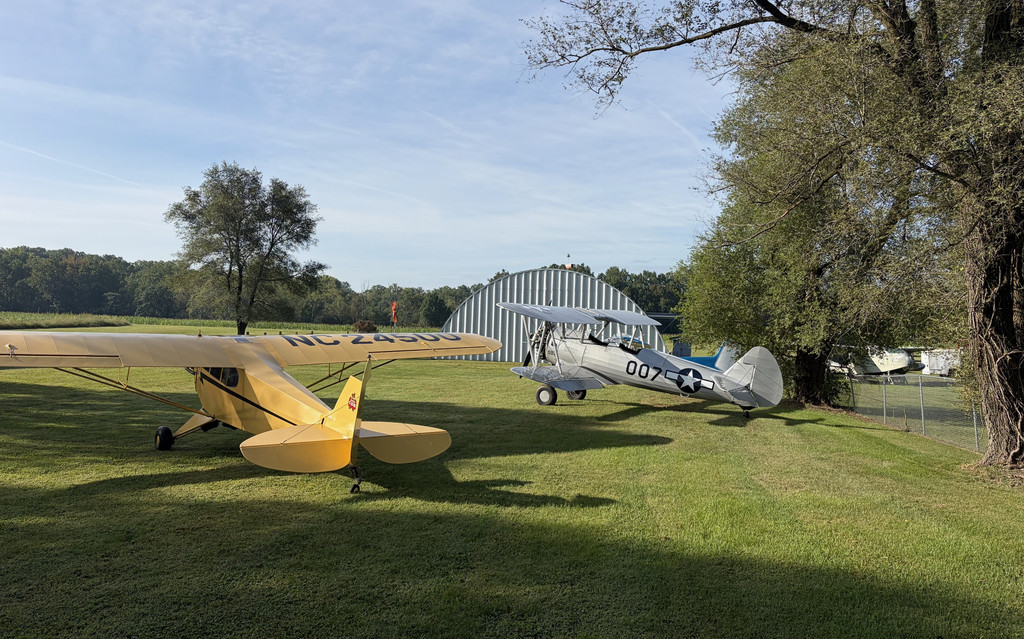
1. Piper Cub for sale: understand which Cub you’re looking at
For many pilots, “Cub” means a yellow J-3 with two seats, a stick, and very little between them and the flying. That’s a reasonable starting point. It becomes less useful when every airplane with a Cub-shaped wing gets described the same way.
A J-3, PA-11 Cub Special, PA-18 Super Cub, and CubCrafters Carbon Cub are different shopping decisions. The J-3 is the simple recreational airplane most people picture. The PA-18 adds the power and equipment associated with a working Super Cub. The Carbon Cub is a separate CubCrafters family with its own models and construction pathways.
The traditional Cub’s strengths come from keeping things simple: tandem seating, stick controls, a light airframe, and modest speed. It suits nearby destinations, practice, and flights that don’t need much of a destination at all. You spend more time managing attitude, coordination, wind, and energy than managing equipment.
The limitation is equally clear. A small cabin, a passenger, fuel, and summer temperatures can leave little room for ambitious plans. A Cub bought for local flying may be a very satisfying purchase. One bought with the expectation that it will do a Super Cub’s job needs a closer look.
Start with the model designation. Then decide whether you want the traditional Cub experience or a different airplane that happens to share the name.
Browse Piper Cub for sale listings.
2. Super Cub for sale: the PA-18 earns its following through usefulness
The Super Cub takes the basic tandem Piper layout and makes it useful for more than an evening flight. Flaps, more power in familiar later configurations, and an airframe with a long working history explain its appeal. The 150-horsepower PA-18 is an important reference point, although the fleet includes other engines and many approved alterations.
Tandem seating gives both occupants a view along the sides without another person beside them. For two people traveling light, that layout works well. Approved wheel, float, and ski installations let suitable examples serve very different jobs.
Much of the used market comes down to how an airplane has been equipped. Extended baggage, extra fuel, larger tires, different gear, and an engine conversion can make one PA-18 a very different purchase from another. Some changes suit a particular job. Some are weight you’ll carry on every flight for a benefit you rarely use.
A light, relatively simple Super Cub deserves consideration alongside the heavily modified examples. A bigger engine can help performance, but low empty weight matters too. Compare what remains for two people, your gear, and the fuel your trip needs.
The PA-18 makes sense when low-speed handling and access to suitable smaller landing areas matter more than cabin width or cruise speed. If the rear seat is occupied regularly, let that passenger try it before you buy.
Explore Super Cub for sale listings.
3. Cessna 180 for sale: a traveling airplane that can do useful work
The Cessna 180 puts the pilot and front passenger beside each other, with more cabin behind them for people or equipment. Its all-metal construction, substantial flaps, and constant-speed propeller support a much broader mission than the small two-seat classics. Original aircraft used a 225-horsepower Continental O-470; later versions commonly used 230-horsepower engines from that family.
The extra power is only part of the reason to look at a 180. The cabin makes it easier to take a passenger and baggage on a trip. The airplane can serve as a personal traveler while retaining the utility that draws owners to approved float, ski, and off-pavement configurations.
For a buyer comparing a 170 and a 180, the difference is substantial. You’re moving from the stock 170’s 145-horsepower, fixed-pitch arrangement into more power and a controllable propeller. That brings more capability and more to maintain. For a buyer comparing a 180 and a 185, the question is whether the 185’s additional performance and loading capability are needed.
Model year and modifications matter. Don’t assume every 180 has the same legal weight, seating, engine, or fuel arrangement. An early, relatively light airplane and a later, heavily equipped one need separate loading calculations.
A 180 is worth studying when you want to go places with useful baggage and still keep tailwheel flying central to the experience.
Compare Cessna 180 for sale listings.
4. Cessna 170 for sale: four seats without jumping straight to a Skywagon
The Cessna 170 gives you a front passenger beside you, a rear seat, and a practical cabin in a classic tailwheel airplane. Stock aircraft used the 145-horsepower Continental C145/O-300 six-cylinder engine. That makes the 170 a different proposition from its more powerful 180 and 185 relatives.
The three main versions are worth understanding:
| Model | The useful distinction |
| Original 170 | Fabric-covered wings and the early wing/strut arrangement |
| 170A | All-metal wing and a revised airframe configuration |
| 170B | Revised wing with dihedral and larger, more effective flaps |
The 170B’s flaps are a meaningful feature for buyers interested in approach and landing flexibility. They don’t turn the stock airplane into a high-powered bush machine. A well-kept 170A may be a better purchase for your flying than a tired B-model bought for its reputation alone.
The rear seat gives you choices: passengers when loading permits, or room for bags and equipment when it doesn’t. That flexibility can be useful even when most flights involve only two people.
If the airplane has an engine conversion, compare its actual weight, balance, propeller, and approvals with the stock example. More horsepower changes the comparison. It also changes the bill.
The 170 deserves a look if your trips don’t require Skywagon performance and you want a classic you can use regularly.
Browse Cessna 170 for sale listings.
5. Cessna 185 for sale: buy the carrying ability when you need it
The Cessna 185 Skywagon is built around utility. Its cabin can accommodate people or cargo in the approved arrangement, and its fuel-injected Continental engine provides the power that makes loaded operations a central part of the airplane’s appeal. Early versions used 260-horsepower engines. Later IO-520 aircraft are commonly described as 300 horsepower for takeoff and 285 horsepower maximum continuous. Check the applicable manual for the installation.
That distinction matters because “300 horsepower” is often presented without context. So is “six seats.” Neither tells you what a particular airplane will carry on your trip.
The practical advantage is that you can consider loads that would rule out many smaller taildraggers: additional people, camping equipment, or other bulky gear. Approved floats and skis broaden the jobs a suitable 185 can do. The airplane also makes sense for owners who need meaningful utility on ordinary flights rather than an occasional ambitious outing.
The compromise is the cost of maintaining that capability. Fuel, a large six-cylinder engine, a constant-speed propeller, insurance, and transition training all belong in the budget. If you mostly fly alone for an hour, you’ll still carry those expenses.
Compare individual 180s and 185s using your real load. You may need the 185. You may find that a good 180 already covers your mission. Either answer is better than buying on horsepower alone.
Explore Cessna 185 for sale listings.
6. Carbon Cub for sale: the letters after the name matter
CubCrafters’ Carbon Cub family brings modern materials, equipment, and substantial power to the light tandem airplane. Its attraction is straightforward: strong performance without needing a large airframe. The used market, however, contains several different answers to the question “Which Carbon Cub?”
| Search designation | What a buyer should establish |
| Carbon Cub SS | Factory light-sport configuration, installed equipment, actual payload |
| Carbon Cub EX, EX-2, EX-3 | Kit model, builder’s work, engine/propeller combination, aircraft documents |
| Carbon Cub FX / FX-3 | Builder-assist history, model-specific equipment and operating limits |
| Sport Cub, Top Cub, XCub | Related CubCrafters products; separate models, not alternate Carbon Cub names |
The SS and the EX/FX branches should not be compared using one gross-weight or performance figure. Nor should a light example with a simple panel be treated as equivalent to an airplane carrying extensive avionics, larger tires, and additional equipment.
For an owner who wants two-person recreational exploring, the appeal can be considerable. Modern cockpit equipment, attention to weight, and the choice of several configurations give buyers room to find a close match.
The buying question is what you get after the equipment is installed. A capable airplane that cannot carry your passenger and fuel together does not fit the trip. With an amateur-built example, construction quality and test history also form part of what you’re buying.
Compare Carbon Cub for sale listings.
7. Citabria for sale: an airplane you can keep learning in
A Citabria can take a pilot from the tailwheel transition into years of useful flying. It offers tandem seating, stick controls, and a range of configurations spanning basic training, personal travel, and approved aerobatic instruction. Champion, Bellanca, and American Champion all appear in the aircraft’s production history.
The model numbers help sort the choices. The 7ECA is generally the smaller-engine, flapless starting point. The 7GCAA brings more power in common configurations without flaps. The 7GCBC adds flaps. The 7KCAB needs its own systems and limitations review, especially if aerobatic use is part of the plan. Factory engine-conversion guidance also shows why an old model designation alone cannot establish the current horsepower.
That range is useful. You can choose a simpler trainer, a flapped airplane for different landing work, or an aircraft appropriate for a broader instructional program. It’s a good category to investigate when you want more to do after the endorsement than repeat the same flight.
The Citabria’s aerobatic reputation needs a little care. Approval for particular maneuvers does not mean every variant has the same inverted fuel and oil systems, loading limits, or capabilities. Compare it with a Super Decathlon if aerobatics are a central goal.
Wood-spar versus metal-spar wings is another substantial buying distinction. Have someone familiar with the type explain the installed wings and their inspection requirements before comparing prices.
Browse Citabria for sale listings.
8. Kitfox for sale: two people beside each other, with choices to make
The Kitfox gives you side-by-side seating in a light recreational airplane. That changes the experience compared with a Cub or RANS S-7: your passenger is beside you, conversation is easier, and navigation can be shared without passing information between seats.
The Series 7 Super Sport and STi show two different priorities within the family. The Super Sport aims at a balance of cruise and short-field usefulness. The STi puts more emphasis on short takeoffs, landings, and low-speed performance, accepting a different cruise compromise. Earlier Kitfox models need to be considered separately.
Folding wings can also be a practical feature. They may help an owner with a suitable storage or transport arrangement, although the procedures and actual fit need to work in your situation. It’s worth measuring the available space rather than treating “folding wings” as a complete hangar plan.
Most importantly, the aircraft’s build and installation choices matter. Engine, propeller, panel, cooling system, gear, and empty weight can vary substantially between used examples. Two Kitfoxes with similar paint and tires may be quite different airplanes.
The Kitfox makes sense if you want a light aircraft you can share comfortably with one person and you’re willing to investigate the individual build. Choose between the variants by the flying you do most, not the shortest takeoff number in the brochure.
Explore Kitfox for sale listings.
9. Cessna 140 for sale: a useful two-seater with familiar controls
The Cessna 140 offers side-by-side seating and control wheels rather than the tandem seats and sticks found in a Cub or Champ. Its small Continental engine and fixed-pitch propeller keep the basic airplane relatively straightforward. Flaps give it a feature the original Cessna 120 lacks.
Wing construction is an important distinction. Original 140s had fabric-covered wings; the 140A introduced an all-metal wing. Some older aircraft have since been changed, so a photo or model name is not enough to establish the construction of the airplane for sale.
For everyday use, the 140 can cover much of what draws a pilot to a small taildragger: local flights, practice, taking a friend along, and occasional longer trips when the pace and weather cooperate. The passenger sits next to you, and the cabin has more of the arrangement familiar to pilots coming from later Cessna trainers.
There isn’t much excess payload to spend carelessly. A heavier engine conversion, elaborate interior, or panel upgrade may improve one aspect of the airplane while reducing what remains for two occupants and fuel.
Try the cabin before getting attached to a listing. Then compare the actual equipment and condition with a 120, Chief, Luscombe, or Taylorcraft. A comfortable, sound example you’ll fly regularly is the useful result.
Compare Cessna 140 for sale listings.
10. Aviat Husky for sale: a certified two-seat utility airplane
The Aviat Husky combines tandem seating, flaps, and a constant-speed propeller in an airplane aimed at utility flying. A-1, A-1A, A-1B, and A-1C models appear in the used market. Aviat’s A-1C configurations include 180- and 200-horsepower versions. Changes across the family make the precise model and year worth studying.
The constant-speed propeller is a useful distinction from many simpler two-seaters. It lets the pilot adjust propeller operation for different phases of flight, while adding another system to operate and maintain. The Husky’s flaps and utility layout suit buyers who put low-speed capability ahead of extra seats.
It belongs in the same shopping conversation as a Super Cub and Carbon Cub, but a demonstration should do more than confirm that all three can leave a runway quickly. Sit in the front and rear seats. Check the controls, visibility, baggage access, and how the airplane feels to you. Those are differences you’ll live with on every flight.
Look closely at the loading sheet. Equipment that makes a Husky attractive in an advertisement still counts against payload. More horsepower does not make the fuel and passenger calculation disappear.
The Husky is worth considering if you want a certified airplane focused on two-person utility flying and its cabin and handling suit you. The particular aircraft matters more than winning a brand argument.
Browse Aviat Husky for sale listings.
11. Aeronca Champ for sale: a good reason to keep practicing
The Champ’s tandem seats, stick controls, and relatively simple systems make it easy to understand why the airplane became a trainer. The familiar 7AC used a 65-horsepower Continental. Later versions and approved engine changes mean that not every Champ shares that specification.
The layout is part of the benefit. Both occupants sit near the centerline, with a view to either side. You feel what the airplane is doing and learn to coordinate it. Modest power encourages attention to airspeed and energy because there is less excess performance available to cover a poor plan.
For an owner who wants local flying and an airplane that keeps inviting practice, that’s useful. The same flight can include work on landings, a visit to another airport, and time spent learning how wind changes the task. There doesn’t need to be a distant destination to make it worthwhile.
The Champ and J-3 deserve a direct comparison, preferably with time sitting in both. Visibility, cabin fit, controls, entry, and the starting arrangement of the actual examples may settle the choice more effectively than reputation.
Be realistic about passenger and fuel weight in a small-engine airplane. If the mission needs substantially more performance, buy for that need. Don’t expect a 65-horsepower trainer to become a different class of airplane because the advertisement shows it on large tires.
Explore Aeronca Champ for sale listings.
12. Piper J3 Cub for sale: decide which version of simple you want
Once you know you want a J-3, the buying questions become more specific. “J3,” “J-3,” and “J3 Cub” commonly lead to the same aircraft type. The familiar Continental-powered 65-horsepower airplane is the reference many buyers have in mind, but surviving Cubs differ in engines, starting arrangements, brakes, fuel, and equipment.
A very simple airplane may suit you perfectly. It may also ask more of your routine. Does it have an electric starter? If not, do you have the training, procedures, and help needed for its starting arrangement? Will a portable radio fit the way you fly, or do you need an installed system? Can your usual passenger get in and out comfortably?
Those questions matter more than whether the paint matches a particular idea of an original Cub.
The attraction remains the direct flying experience. You can spend an hour working on coordinated turns and landings without feeling that you’ve underused the airplane. For pilots who want to improve their basic flying, that is a good quality.
The J-3 is also an airplane where restoration details matter. Ask what happened beneath the new fabric, not just when it was applied. A documented structural inspection and repair history can be worth more than a spotless panel.
Check the individual airplane’s approved solo seating position and operating information. Familiarity with the name is no substitute for learning the aircraft you’re about to fly.
Browse Piper J3 Cub for sale listings.
13. Maule aircraft for sale: put cabin access on the comparison sheet
Maule gives tailwheel buyers a range of cabin aircraft rather than one standard configuration. M-4, M-5, M-6, M-7, and MX-7 searches cover different wings, engines, loading limits, and equipment. Some related models have nosewheel gear, so the full model designation matters.
For a pilot outgrowing a two-seater, a Maule’s useful feature may be the cabin itself. More room for people and baggage changes which trips you can consider. On examples with generous door access, getting bulky camping equipment in and out can be less of a production than forcing it through a small opening.
That makes the Maule worth comparing with a Cessna 180 or 185. Start with your load, then look at how that load fits through the doors and sits inside the approved cabin arrangement. A useful airplane has to accommodate the shape of the cargo as well as its weight.
The broad model range means a single claim about “Maule performance” is not very helpful. A smaller-engine aircraft and a high-powered utility version need separate evaluations. So do their fuel, maintenance, and insurance costs.
Look for an example whose equipment fits your normal flying. If you only need a modest load and good cabin access, you may not need the highest-powered version. If the mission is demanding, verify the actual aircraft’s numbers rather than buying on the family’s short-field reputation.
Compare Maule aircraft for sale listings.
14. Cessna 120 for sale: fewer features can be enough
The Cessna 120 began as the simpler companion to the 140. It has the same basic two-seat, side-by-side purpose, but the original configuration left out the 140’s flaps and some of its equipment. Decades of changes mean a present-day 120 may not resemble that original equipment list closely.
For local recreational flying, the simpler version may give you everything you need. Without flaps, approach planning depends on managing speed, flight path, and the techniques appropriate to the airplane. That can be useful practice in a purchase aimed at basic flying.
A used 120 also makes sense as a comparison that keeps you honest about equipment. If you don’t need a large panel or extensive electrical accessories, why pay to buy and maintain them? On the other hand, an installed starter or radio may be worth its weight if it makes the airplane easier for you to use.
Look at the particular 120 and 140 beside each other. Compare cabin fit, wings, engine, equipment, and actual condition. The better-maintained airplane may be the better purchase even if it has fewer features.
The goal isn’t to win the argument over which model is better. It’s to find a small taildragger that suits the flights you’ll make and leaves enough in the budget to make them often.
Browse Cessna 120 for sale listings.
15. Super Decathlon for sale: buy it with a learning plan
The Super Decathlon has a clear purpose. American Champion’s 8KCAB uses a 180-horsepower Lycoming AEIO-360, inverted fuel and oil systems, and a wing designed for aerobatic work. Those are substantial differences from treating a Citabria as an all-purpose trainer that can also perform some approved maneuvers.
Tandem seats and dual controls let an instructor work with you on precision and aerobatic skills. The inverted systems support operations a conventional fuel and oil arrangement cannot sustain. They do not remove maneuver, loading, or duration limits; those still come from the airplane’s documents.
The reason to buy one is what you intend to learn. If you want regular aerobatic instruction, the airplane gives that ambition a practical home. If you want to improve handling with qualified instruction, it offers room to keep working after the tailwheel endorsement.
If most flights will be to lunch with a passenger, you should decide whether you’ll actually use the aerobatic equipment you’re paying for. A Citabria may cover your needs. If aerobatics are central, the Super Decathlon’s systems become much easier to justify.
Past use deserves informed inspection. Aerobatic and instructional hours aren’t automatically a problem, but the structure, repairs, controls, wings, and maintenance should be reviewed by someone who knows the type. Buy an airplane ready for the training you plan, then arrange that training.
Explore Super Decathlon for sale listings.
16. Stinson 108 for sale: room for the people who come flying with you
The Stinson 108 is a four-seat, fabric-covered cabin airplane. Original 108 and 108-1 models used 150-horsepower Franklin engines; the 108-2 and 108-3 used 165-horsepower versions. Engine conversions add more variation to the used market.
Its advantage over the small two-seat classics is easy to use even when the rear seats are empty. You have more cabin for bags, jackets, and the things that accompany an actual trip. When weight and balance permit, you can take additional passengers rather than choosing which friend gets the invitation.
That puts the 108 in the conversation with the Cessna 170 and Pacer. Compare seating comfort and baggage access along with the engine and airframe. The better airplane for your household may be the one people can get into comfortably and want to fly in again.
Franklin support should be settled before the purchase. Find the mechanic who will maintain the installed engine and ask how parts and major work would be handled. A converted example requires the same specific inquiry about its own installation. An engine name by itself doesn’t answer the support question.
A sound Stinson may be a useful way to combine classic-airplane ownership with trips that need more cabin. Its value depends on the individual airplane and the work ahead, not an assumption that every vintage four-seater is a bargain.
Compare Stinson 108 for sale listings.
17. Piper Pacer for sale: a four-seat short-wing Piper
The PA-20 Pacer offers side-by-side front seats, a rear seat, flaps, and a compact short-wing layout. It is a different airplane from the long-wing, tandem Super Cub. A Pacer search also includes PA-22/20 conversions: aircraft built as nosewheel PA-22s and later converted to tailwheel gear.
The original Pacers came in several engine configurations, including familiar 125- and 135-horsepower versions. Conversions and later changes mean the actual engine can differ. Compare the installed aircraft instead of assuming all Pacers have one power rating.
The cabin is what makes it worth considering. You can share the front seat, use the rear area for baggage, or carry additional occupants when the loading works. For flying to nearby events or taking a modest trip, that may be more useful than the seating arrangement of a tandem two-seater.
A converted PA-22/20 can be a good aircraft, but it should be described and evaluated as a conversion. Examine the approval records and workmanship. It doesn’t become an original PA-20 because the wheels are in similar places.
This is also a category where a low purchase price can be misleading. Engine support, fabric condition, structural history, and records can outweigh the apparent saving. If the history beneath a recover is uncertain, a seller’s confidence doesn’t fill the gap.
Browse Piper Pacer for sale listings.
18. Taylorcraft for sale: look beyond the Cub and Champ
The Taylorcraft gives buyers another way into small, simple tailwheel flying. The familiar BC12-D puts two people side by side behind a Continental A-65 in its original configuration. Related models and later Taylorcrafts have different engines, weights, and fuel arrangements.
The side-by-side cabin and control wheels are useful distinctions from a Cub or Champ. If your normal flight includes a passenger, shared conversation and navigation may matter more than sitting on the centerline. The airplane deserves a place in the comparison before you decide which small classic feels right.
The BC12-D’s modest power also makes weight important. A traditional, lightly equipped example has a different set of priorities from an airplane carrying added electrical equipment and a more elaborate interior. Neither is automatically better. You need to know what the changes leave for people and fuel.
Model details can be more consequential than they first appear. The Taylorcraft Foundation’s archived specifications show differences even within closely related BC12 designations, including doors and auxiliary fuel arrangements. Use the documents to establish what you’re inspecting.
For an owner who wants frequent local flying, a good Taylorcraft can be worth more attention than its place in a brand popularity contest suggests. Choose on fit, condition, and support, then leave room in the budget to fly it.
Explore Taylorcraft for sale listings.
19. Stearman for sale: the experience comes with a maintenance bill
A Stearman gives you two open cockpits, a radial engine, and a biplane airframe with a direct connection to military primary training. The Boeing Stearman Model 75 family includes several designations. Originally, PT-13s used Lycoming engines, PT-17s used Continentals, and PT-18s used Jacobs engines. Surviving aircraft may have approved changes, so check what is actually installed.
The open cockpit is the point. The sounds, airflow, and view make a short flight a different experience from an enclosed cabin trip. If that’s what you want to own and share, a comparison based only on cruise speed is going to miss why you’re shopping.
The size matters on the ground. Confirm hangar width, height, door clearance, and how the airplane will be moved before making a commitment. Establish radial-engine support, insurance, and a transition instructor at the same time.
With a Stearman, inspection involves more than an engine and a covering date. Biplane rigging, wing structure, controls, landing gear, fabric, and restoration records all deserve specialist attention. A beautiful exterior may be the result of excellent work. You still need the evidence.
This is a good purchase for someone who wants the responsibility as well as the flight. If you only want the occasional open-cockpit experience, taking a flight in someone else’s Stearman may be the more sensible arrangement.
Compare Stearman for sale listings.
20. RANS S7 for sale: tandem flying in a light kit aircraft
The RANS S-7 Courier family offers two-seat tandem flying in a light, fabric-covered airplane. The S-7S is an important model in the used market. RANS’ published reference configuration uses a 100-horsepower Rotax 912 ULS, two doors, and a rear baggage area.
The manufacturer’s October 2020 reference sheet lists 26 gallons of fuel capacity and a 50-pound baggage limit. Those figures help describe that configuration, but an advertised airplane’s own documents and equipment must settle the purchase. A different engine, empty weight, or approved arrangement changes the calculation.
For the buyer, the combination offers a clear purpose: one passenger, a modest amount of gear, and recreational trips in a relatively light aircraft. Tandem seating gives each occupant a view along the sides; a Kitfox offers a useful side-by-side comparison for much the same shopping exercise.
A Rotax installation brings different maintenance needs from an older air-cooled Continental trainer. Find local support for the engine and its cooling, fuel, and propeller installation. That should happen before you discover a maintenance need after purchase.
With an amateur-built example, builder choices count. Review the construction and test history alongside current condition. You’re buying a completed aircraft, not the specifications of a kit. A careful build that fits your normal load is more useful than an impressive list of changes you don’t need.
Browse RANS S7 for sale listings.
21. Piper PA12 for sale: the rear bench changes the comparison
The PA-12 Super Cruiser puts the pilot in front and two seating positions on a rear bench. That makes it a different cabin arrangement from the two-seat PA-18. Its roots are in the J-5 Cruiser, and the original PA-12 was a small-engine utility airplane rather than a high-powered modern backcountry machine.
That third seating position is worth investigating if it matches the people you fly with. It may also be useful to have the cabin space without carrying three occupants. Check the actual rear-seat fit, restraints, loading, and baggage arrangement before deciding how useful it will be to you.
The used market includes aircraft that remain relatively close to their original configuration and others that have been changed extensively. Larger engines, different gear, fuel changes, baggage alterations, and other work can move individual aircraft toward quite different jobs.
That variation is why a PA-12 deserves its own comparison. Calling a modified one “like a Super Cub” does not establish the same weight, handling, structure, or operating information. Check the aircraft that was actually built and approved.
For buyers who like the traditional Piper layout but want the Super Cruiser’s cabin, the PA-12 is worth a serious look. The useful example is the one whose modifications, empty weight, and seating work together for your mission. More alterations do not automatically add up to a better airplane.
Explore Piper PA12 for sale listings.
22. Luscombe 8A for sale: know the wings and fuel system
The Luscombe 8A combines a metal fuselage, side-by-side seating, stick controls, and a small Continental engine. The familiar original 8A used the 65-horsepower A-65. It belongs in the same shopping group as the Cessna 120/140, Chief, and Taylorcraft, but it has details worth understanding before comparing prices.
Start with the wings. A metal fuselage does not establish an all-metal airplane: the 8A’s original configuration used fabric-covered wings. Then look at the fuel system. Early 8-series configurations used a fuselage tank, while later 8E and 8F models introduced different engines and wing-tank arrangements. Alterations can change what is installed today.
Those are practical differences. Fuel location, capacity, starting equipment, and engine choice affect how you use the airplane. A listing that says only “Luscombe Silvaire” leaves useful questions unanswered.
For local flying, the 8A offers a compact airplane with direct controls and a shared cabin. A buyer who enjoys working on precise landings and coordinated flight has plenty to do without an elaborate panel.
Check the fit of both occupants and get an informed look at corrosion, landing gear, and wing condition. The best choice may be a relatively simple aircraft with good records. Paying extra for cosmetic work is harder to justify if important structural questions remain open.
Compare Luscombe 8A for sale listings.
23. Cessna 190 for sale: the Continental-powered member of the family
The Cessna 190 shares the enclosed cabin and cantilever high-wing appearance of the 190/195 family. The key original distinction is the engine: the 190 used a Continental radial, while the 195 used Jacobs power. The familiar 190 configuration produced 240 horsepower.
That makes the engine a central part of the buying decision, even when two advertisements make the aircraft look nearly identical. Find out who supports the installed Continental, what the records show, and how major maintenance would be handled. A general willingness to work on piston airplanes is not the same as experience with this installation.
The cabin offers a way to share radial-powered vintage flying without open cockpits. For an owner who enjoys the airplane’s history and wants room for passengers when loading permits, that can be a strong reason to look beyond the smaller classics.
It also needs space and support. Check hangar fit and handling arrangements before the airplane arrives. A low asking price relative to a 195 may be attractive, but it doesn’t establish lower ownership costs.
The 190 makes the most sense when you specifically want this combination of airframe and engine and have the help to care for it. If you’re considering one mainly because it’s cheaper than the aircraft you originally wanted, investigate that reasoning before investigating the paint scheme.
Browse Cessna 190 for sale listings.
24. Cessna 195 for sale: a cabin classic with a Jacobs radial
The Cessna 195 Businessliner has an enclosed cabin, a cantilever wing, and a Jacobs radial. Its size and appearance give it a presence few small airplanes share. The 195, 195A, and 195B include differences in engines and equipment, and surviving aircraft may have further changes.
The appeal is having room to share a vintage flight while sitting inside a cabin. That separates it from a Stearman. Its larger airframe and radial engine separate it just as clearly from a small two-seat classic.
For the right owner, maintaining and preparing the aircraft is part of the enjoyment. You’re looking after machinery that needs specific knowledge, not simply keeping a generic four-seat airplane available. That calls for a mechanic familiar with the Jacobs installation and the 190/195 airframe, plus an ownership budget that allows for the work.
The practical comparison should include hangar dimensions, engine and propeller support, insurance, and transition instruction. Ground visibility and directional control deserve focused attention. A pilot comfortable in a smaller taildragger should still plan to learn this airplane properly.
Restoration quality is especially important. Ask what was inspected, what was repaired, and what has happened since. An aircraft restored years ago has continued aging and being used. The work can be excellent and still need a careful present-day inspection.
Explore Cessna 195 for sale listings.
25. Aeronca Chief for sale: put the passenger beside you
The postwar Aeronca Chief shares much of the Champ’s basic small-airplane approach, but puts the occupants beside each other and gives them control wheels. The 11AC, 11BC, and 11CC Super Chief belong in a model-specific comparison. Earlier aircraft also carried the Chief name, so “Aeronca Chief” alone does not settle the design.
For someone who normally flies with a spouse or friend, the seating arrangement is a real feature. You can talk, share navigation, and look at the panel together. That may be a better fit than tandem seats, regardless of which aircraft has the stronger following at your airport.
The familiar 11AC’s small Continental engine and simple systems keep the airplane focused on ordinary recreational flying. It is a candidate for local trips, practice, and visiting nearby fields when conditions suit. It does not need to be fast or heavily equipped to do that job.
The buying questions are physical as well as mechanical. Can both occupants sit comfortably? Is access workable? Does the installed starting arrangement fit how you operate? Will your combined weight leave room for the fuel you need?
Compare a Chief and Champ in person if you can. The aircraft are close enough in purpose that seating, controls, and the condition of the examples available may decide the purchase. That is a better basis than assuming the more familiar model must be the better airplane for you.
Compare Aeronca Chief for sale listings.
Before you buy: five things worth getting right
The model gets you interested. The individual aircraft determines what you’ll own. These checks apply across the list, so they belong in one place rather than at the end of every review.
1. Load the airplane you’re buying
Use the current weight-and-balance report and equipment list. Work out your normal trip with the actual occupants, fuel, and baggage. Check center of gravity and individual compartment limits, not just gross weight.
Four seats are four seating positions. They are not a promise of four adults and full fuel. The same applies to two people in a light airplane with a long list of accessories.
2. Find out what “restored” means
New fabric and paint tell you what the outside looks like. Ask what was inspected and repaired underneath, who did the work, and where it is documented. For a metal airplane, investigate corrosion and repairs with the same attention.
Missing early logs leave uncertainty. An inspection can answer some condition questions, but it cannot recreate an undocumented history. Decide what that uncertainty means for your purchase and eventual resale.
3. Compare the engine’s history, not one number
Time since overhaul matters. So do calendar time, regular use, the overhaul’s scope, and evidence of present condition. Low time is less reassuring when the engine has spent years sitting.
Know who will maintain the installation and what major work would involve. This deserves particular attention with older engine families, radials, Rotax installations, and conversions unfamiliar to your usual shop.
4. Have the modifications reviewed together
An engine conversion, extra fuel, larger tires, and different gear may each have a purpose. Together they change weight, balance, drag, and maintenance. A long equipment list does not tell you whether the resulting airplane fits your trip.
For certified aircraft, have the approvals and maintenance records reviewed. For amateur-built aircraft, examine construction quality, airworthiness documents, operating limitations, and test history. Either category can contain excellent aircraft or expensive problems.
5. Arrange the instruction and insurance first
Get a quote for the actual aircraft and your experience. Find the instructor who will help you transition. Do that before the sale, when the answers can still change the decision.
A tailwheel endorsement is a starting point. A Champ, a Skywagon, and a Stearman each need their own learning. Leave money and time for that work, then fly often enough to keep it useful.
Questions buyers ask about tailwheel aircraft for sale
What is a good first tailwheel airplane?
A sound Cub, Champ, Citabria, or Cessna 120/140 can be a useful starting point, depending on your needs. Instruction, insurance, cockpit fit, and local maintenance support should narrow the choice. An airplane you can get good instruction in is a better start than one bought mainly on reputation.
Which taildragger is best for taking the family?
Start with the Cessna 170, 180, and 185, Maule, Stinson 108, and Pacer. Then calculate your actual load and try the cabin. Seat count alone won’t answer the question, and children and baggage have a habit of getting larger.
Should I buy a Super Cub, Carbon Cub, or Husky?
Compare the individual aircraft with your passenger, fuel, and gear in mind. The Super Cub offers a long-established certified utility design and many modifications. The Carbon Cub family offers several modern configurations and construction pathways. The Husky offers another certified tandem utility design with model-specific differences. Cabin fit, actual payload, handling, and ownership support matter more than deciding which name wins.
Is a tailwheel airplane automatically suitable for backcountry flying?
No. The gear arrangement tells you where the wheels are. It doesn’t establish takeoff performance, landing capability, surface suitability, structural limits, or pilot proficiency. Plan around the actual airplane, runway, load, weather, and obstacles.
What is the difference between Piper Cub and Piper J3 Cub searches?
They often refer to the same airplane. J-3 identifies the model more precisely; Cub is sometimes used loosely for related aircraft. Confirm the designation in the listing before comparing it with a PA-11, PA-12, PA-18, or a CubCrafters product.
Is an experimental taildragger a better buy than a certified one?
It depends on the aircraft and how you’ll use it. Compare the operating framework, construction or repair history, maintenance arrangements, and quality of the particular airplane. A good builder’s work can be valuable. A familiar certified model can still have decades of repairs that need to be understood.
How much should I budget beyond the asking price?
Get real estimates for insurance, storage, the inspection, transition instruction, routine maintenance, and engine and propeller reserves where applicable. Include the work you already know is approaching. There is no useful universal percentage that turns an asking price into the full cost of ownership.
Buy something you’ll want to fly next Saturday
A taildragger doesn’t need a large engine, large tires, or a distant destination to be worth owning. It needs to fit your flying well enough that you’ll use it.
The right answer might be a two-seat classic that keeps the cost manageable. It might be a four-seat cabin airplane that lets more people come along. It might be an aerobatic airplane because you’re ready to learn something new.
If you haven’t earned your tailwheel endorsement yet, start there. Time with a good instructor can help you decide what you like before you commit to owning it. You can find a tailwheel instructor in the Taildraggers.com tailwheel training directory.
Explore the tailwheel aircraft listings throughout this guide on Taildraggers.com. Find an airplane with the condition, support, and capability you need. Leave room in the budget for instruction and fuel.
Then give yourself a reason to go flying.
